Material choices in Anchorage are judged by one test: how they behave after five months of frost, plows and studded tires. Here is how the options compare, and what a slab needs for common uses.
The price ranges on this page are national figures published by HomeGuide for 2026. They are not our quotes. Alaska labor and material costs, a short building season, access and the ground under your slab all move the real number. Last checked October 2026.
Concrete or asphalt for a driveway?
Both work here, and asphalt is the more common of the two. Asphalt costs less to put in, $5 to $12 or more per square foot nationally against $6 to $15 for concrete, and it bends a little when the ground heaves. Its weak points are ruts from studded tires and the need for regular seal coats. Concrete lasts longer and holds its shape, but it needs a drained base and must be kept free of deicer in its first winter.
Poured concrete or pavers?
Pavers cost $10 to $17 per square foot nationally for a patio, against $4 to $12 for plain concrete. Pavers can be lifted and reset after frost moves them, which is handy. They also shift one by one, catch a plow blade or snow blower, and grow weeds in the joints. Poured concrete is one piece, shovels cleanly and costs less. For a driveway that gets plowed, most people here are happier with a slab.
How thick should a concrete driveway be?
A concrete driveway should be at least 4 inches thick for cars, and 5 to 6 inches where pickups with plows, motorhomes or loaded trailers park. In Anchorage the layer below matters as much. A deep bed of compacted, free-draining gravel in place of silt or peat does more against heaving than an extra inch of concrete.
Do I need rebar or wire mesh?
For a driveway or garage floor here, we recommend rebar or wire mesh. Steel does not prevent cracking, but it keeps cracks narrow and stops one side from stepping above the other when frost lifts the slab. Rebar on supports is easier to keep in the middle of the slab than mesh. Small patios and walks on good gravel can go without.
What PSI concrete do I need?
For outdoor concrete in a hard-freeze climate, the usual recommendation in the trade is around 4,000 to 4,500 PSI with entrained air. The air matters as much as the strength. It is a network of tiny bubbles, about 5 to 7 percent of the mix, that gives freezing water room to expand. Ask for both numbers on the quote. Indoor floors that never freeze do not need the air.
Is stamped concrete worth it?
Stamped concrete is worth it on a patio or front walk if you like the look and accept the upkeep. It costs $8 to $19 per square foot nationally and needs resealing every few years. On an Anchorage driveway it is harder to justify, because studded tires and sand wear the color and sealer. Many owners stamp the patio and broom the driveway.
Should I seal new concrete, and when? How often after that?
Yes, you should seal new concrete here, because keeping water out is the best defense against flaking. A penetrating sealer goes on after the slab has cured, usually about a month after the pour, and before the first freeze. A slab poured in September may not have time, which is one reason to pour earlier. National sealing cost is $1 to $3 per square foot, or $575 to $1,700 for a two-car driveway.
How often depends on the product and the wear. Penetrating sealers on plain concrete commonly last several years. Film sealers on stamped or colored work wear faster, and a driveway that sees studs and sand may need a coat every two or three years. A simple test: if water soaks in and darkens the surface, it is time.
Broom finish or smooth finish? What about a steep driveway?
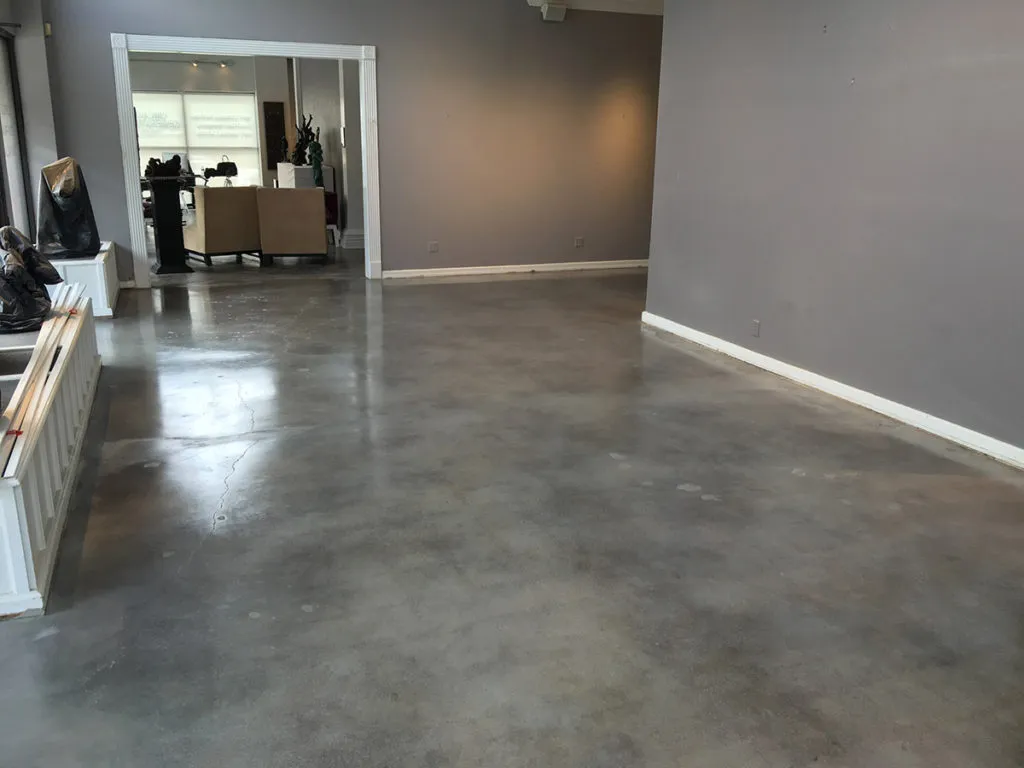
Outdoors in Anchorage, choose a broom finish. The fine ridges give grip on a wet or frosty morning and hide wear. A smooth, steel-troweled finish belongs indoors, on garage and shop floors, where it is easy to sweep and squeegee. Exposed aggregate is another good outdoor option with strong traction.
On a steep driveway use a heavy broom finish with the lines running across the slope, or a grooved finish on the steepest part. No finish gives grip through solid ice, so on Hillside and Eagle River grades people also think about drainage to keep meltwater off the drive, and sometimes snow-melt heat in the wheel paths.
What does a hot tub pad need?
A hot tub pad needs to be level, reinforced and thick enough for the load in the tub maker's manual, since a full tub weighs thousands of pounds. We set it on compacted gravel so it does not tilt with frost, slope the surroundings away, and broom the surface for wet feet. Plan the electrical conduit before the pour.
What does a shop slab need for a vehicle lift or heavy equipment?
A vehicle lift needs the slab thickness and concrete strength the lift maker specifies at the posts, and those figures should be in hand before the pour. For heavy equipment the whole slab is thicker with more steel and closer joints. Many Alaska shops are heated through the floor, so insulation and tubing go in first and joints are placed to miss the lift anchors.
Do I need gravel under a slab? Do I need a vapor barrier?
Yes. Gravel under a slab is not optional here. It is the main protection against frost heave, because clean gravel drains and does not hold the water that forms ice. How deep depends on the soil it replaces. Over native gravel a few inches may do. Over silt or peat the dig can be a foot or far more.
Under any enclosed floor, yes. A vapor barrier is a heavy plastic sheet that stops ground moisture from rising through the slab into a garage, shop or living space, where it ruins coatings and flooring. Under an outdoor driveway or patio it is not used.
What does a pad need if delivery trucks will drive on it?
A pad that takes a delivery truck, a fuel truck or a septic pumper needs to be designed for that axle load. Expect 6 inches or more of concrete, rebar, a deeper gravel base and thickened edges. A standard 4-inch driveway will crack under a loaded truck, most often in spring when the ground beneath is soft from thaw.
My pool deck or spa deck is worn. Resurface, pavers or new concrete?
If the pool deck slab is solid, resurfacing with a textured coating is the least costly, at $3 to $6 per square foot nationally. Pavers suit a deck where access to buried lines matters. New concrete is the choice when panels have sunk or heaved. Around an outdoor spa in Anchorage, pick whichever option drains fastest and has the most texture.
The patio will sit against the house. What goes between them?
An isolation joint, sometimes called an expansion joint, goes between the patio and the house. It is a strip of compressible material the full depth of the slab. The house sits on deep footings and the patio floats on the surface, so they move differently with frost and in an earthquake. The joint is then sealed at the top so meltwater does not run down the foundation wall.
The only real price is one written after we have seen the site. Call (907) 331-4363 or text us a photo of the area to set up a free on-site estimate.