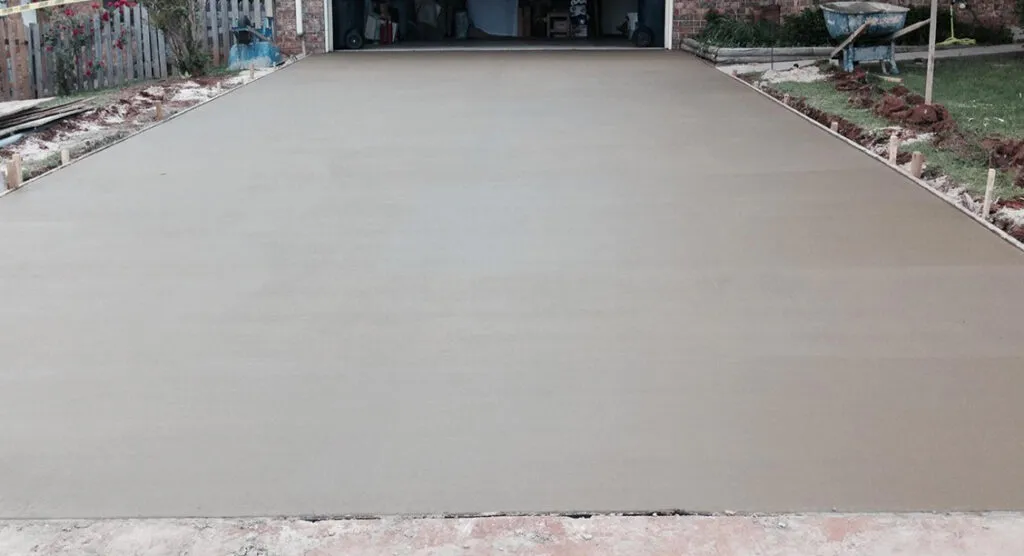
We pour new driveways and replace old ones across the Anchorage Bowl and nearby towns. Frost heave is what ruins driveways here, so the quote starts with how deep we dig and how much gravel goes back. The entrance at the street has to follow the municipal driveway standards.
A driveway in Anchorage lives a hard life. It freezes for five or six months, carries studded tires, gets scraped by a plow blade and then sits under running meltwater at breakup. What keeps it in one piece is under the surface. We dig out silt, peat and topsoil, because those soils hold water and lift when they freeze. Clean, compacted gravel goes back in so water drains away before it can turn to ice under the slab.
The concrete itself is ordered for the climate. That means an air-entrained mix, which has tiny air bubbles that give freezing water room to expand, and enough strength to stand up to deicer carried in on tires. We place control joints so the slab cracks in straight lines where we choose, and an isolation joint at the garage so the driveway and the house can move separately in a frost cycle or an earthquake.
Most driveways are poured between May and September, when the ground has thawed and nights stay above freezing. A typical job is a day or two of tear-out and base work, one day to pour, then about a week before cars go on it. The part of the driveway that crosses the road right of way has to follow the municipal driveway standards, and we check those for your street before we quote.
Concrete driveways in Anchorage: common questions
Why did my Anchorage driveway heave over the winter?
Water in the soil under it froze and expanded. Silty and peaty ground does this the most. The lasting fix is to remove that soil, put in free-draining gravel and give meltwater a way out, not to pour a thicker slab on the same ground.
Can you pour a driveway in Anchorage in winter?
It is possible with heated enclosures and blankets, but it costs more and carries more risk, so most driveways wait for thawed ground. Concrete must never be placed on a frozen base, because the base settles when it thaws.
How wide can my driveway be at the street?
The municipal driveway standards set that. For homes on local roads the standard width is 12 to 28 feet, and the driveway entrances together should not take up more than 40 percent of the lot frontage, with an exception for narrow lots. We check your street before we form anything.
How it works
- Free estimate: Call, text or book online. We visit and measure.
- Written quote: Clear pricing with finish options.
- Prep & forms: We excavate, grade, compact the base and set forms and reinforcement.
- Pour, finish & cure: We pour, finish, cut control joints and tell you when you can use it.